It’s been quite a few weeks now since I finished the apothecary set, and I’ve been busy choosing and researching my next project. There are a lot of ideas for miniature sets I want to make, but I finally narrowed it down to one. It’s going to be another shop, a mid-eighteenth century cordwainer’s (shoe maker’s) shop, to be very precise.
Phew! What a mouthful, but worth it, because I love everything about this one already; the colours, the styles, the tools! I could go on, but I’ll spare you the drooling.
I decided to stay in the eighteenth century after the apothecary shop as it was a time when craftspeople abounded in Europe. As a history enthusiast and crafter, this era of guilds and bustling trades holds endless fascination for me. You only have to scan the contents page of the book of trades to get an idea of the vast variety of crafts that existed in the eighteenth and nineteenth century.
History aside, there were two other reasons for my choice, the first is the sheer material available on the subject. Museums, paintings, books, blogs and much more have all helped inform my research on how shoes looked and were made (I’m finding that there is much less information on what a shoemaker’s shop might have looked like).
The second is the challenge. I’ve made clothes for dolls in the past, but never shoes. It just seemed impossible that functioning footwear could be made for such tiny feet, so before casting away onto the sea of research, I had to check that it could be done. And more importantly, that I could do it.
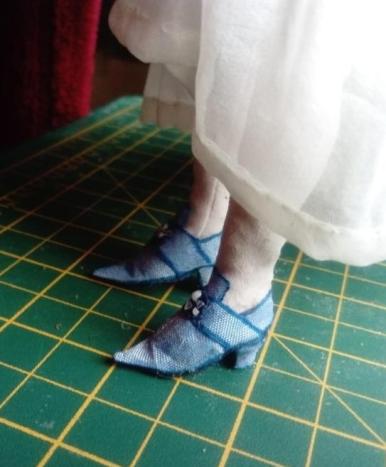
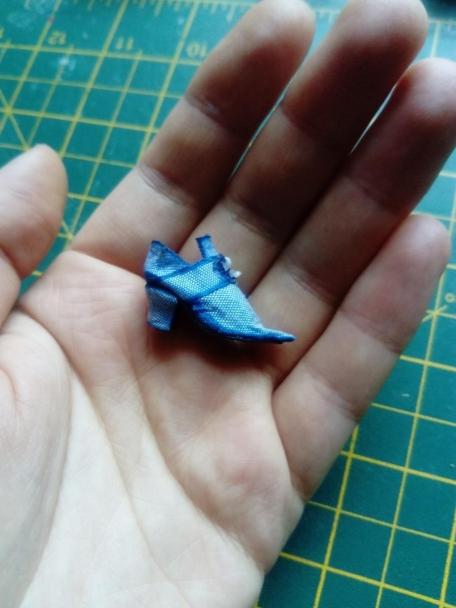
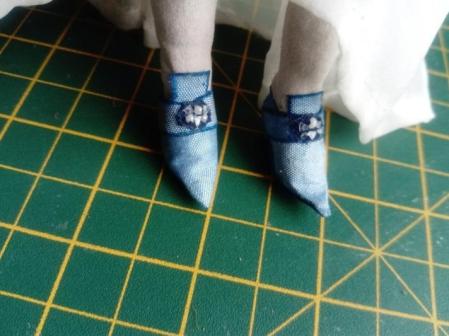
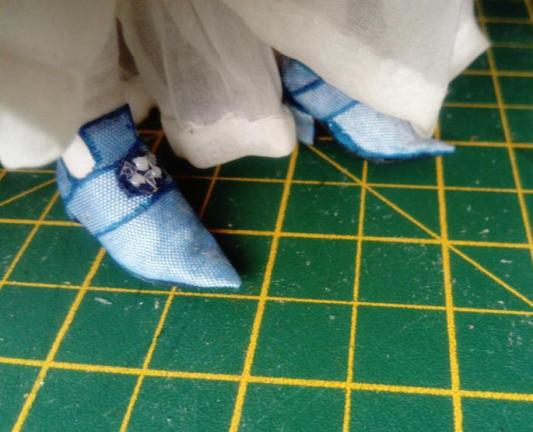
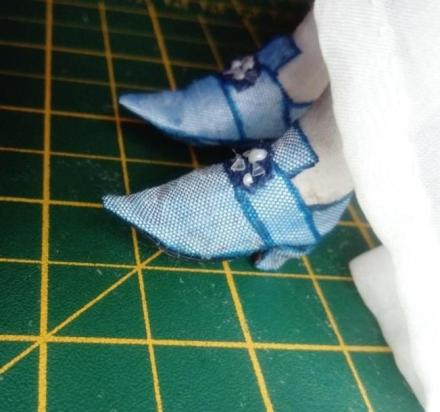
Not too long after idly contemplating the idea of making a shoe shop, I stumbled across this tutorial by Adele Po, on Pinterest. It was a great starting point, and with a few tweaks to the style (to look more eighteenth century) and the technique (to make the shoes removable), I made my first pair of miniature shoes. It took ages! I didn’t count the hours, that would have been too soul crushing, but I was fairly happy with the result, and critically, eager to make more pairs. Unfortunately I have no photos of this process, but I will definitely be documenting my subsequent experiments more thoroughly.
For these shoes I used card (varying thicknesses) for the soles and heels, and silk for the fabric of the shoe. To prevent the silk from fraying, I brushed it down with a mixture of water and PVA. This does reduce some of the shine of the fabric, and darken it a little, but on a small scale this is not very noticeable. To give the shoes more definition I used a dark blue marker on all the edges.
After that I threw myself into research while also experimenting with the making of the shoes. My next post will be an in depth view of my methods of miniature shoemaking and my experiments to improve the design.
 Magpie's Workshop